

Jasmine Crockett’s Senate Ambition: From House Spotlight to Texas Showdown
An Independent’s Perspective on Her Rise, Risks, and the Road to Relevance in a Red State

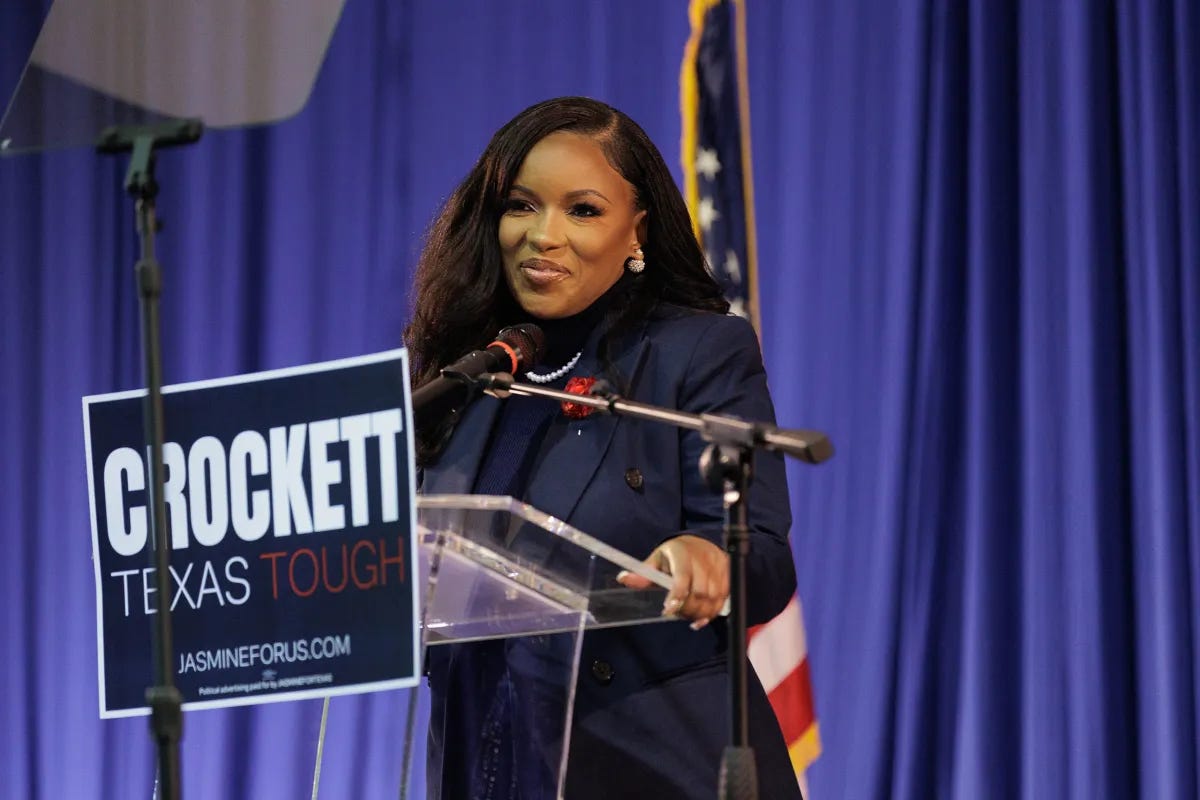
As an independent observer, the announcement of Rep. Jasmine Crockett’s (D-TX) bid for the U.S. Senate on December 8, 2025, marks a bold escalation in her political career. Elected to the House in 2022, Crockett has quickly become a national figure known for her fiery rhetoric and unapologetic advocacy. Now, she’s vacating her safe Dallas-area seat to challenge Republican incumbent Sen. John Cornyn in 2026—a move that highlights Democratic ambitions but underscores the steep odds in a reliably red state. This analysis reflects views shared by many independents: admiration for her energy, skepticism about her statewide viability, and a call for pragmatic shifts to appeal beyond party lines. We’ll explore her House tenure, reasons for the switch, primary and general election expectations, holdbacks, and necessary changes for a real shot.
Crockett’s Time in the House: A Rapid Rise as a Progressive Firebrand
Jasmine Crockett, a 44-year-old civil rights attorney and former Texas state legislator, burst onto the national scene after winning Texas’s 30th Congressional District in 2022, succeeding longtime Rep. Eddie Bernice Johnson. Her district, encompassing southern Dallas and its suburbs, is a deep-blue stronghold with a diverse, predominantly Black and Hispanic population. In her two terms (she’s currently in her second), Crockett has positioned herself as one of Congress’s most outspoken Democrats, leveraging committee assignments on Oversight and Accountability, Agriculture, and the Judiciary to amplify progressive causes.
Her achievements include viral moments that boosted her profile: a heated exchange with Rep. Marjorie Taylor Greene (R-GA) in May 2024, where Crockett quipped about “bleach blonde bad built butch body,” drawing millions of views and merchandise sales; clashes with Rep. Nancy Mace (R-SC) over white privilege; and sharp critiques of Texas Gov. Greg Abbott’s border policies, which she called “inhumane.” These incidents have earned her a massive social media following—over 1 million on X and TikTok combined—and frequent cable news appearances on MSNBC and CNN. Policy-wise, she’s championed criminal justice reform, voting rights, and affordable housing, co-sponsoring bills like the George Floyd Justice in Policing Act and pushing for federal oversight of state voting laws. As a member of the Progressive Caucus, she’s advocated for bold ideas like Medicare for All and the Green New Deal, aligning with figures like Rep. Alexandria Ocasio-Cortez.
From an independent viewpoint, Crockett’s House record shows genuine passion for marginalized communities, but it’s light on bipartisan wins. Her style—blunt, confrontational—resonates in echo chambers but has yielded few cross-aisle collaborations in a divided Congress. Many independents appreciate her accountability push but question if it’s more performance than progress.
Why She’s Leaving the House: Maps, Momentum, and Bigger Ambitions
Crockett’s decision to leave the House stems from a mix of opportunity and necessity. On December 4, 2025, the U.S. Supreme Court upheld Texas’s redrawn congressional maps, which add five Republican-leaning seats and squeeze Dallas-area Democrats. This leaves three incumbents—Crockett, Allred, and Marc Veasey—vying for just two safe Democratic districts, potentially forcing a messy primary. By jumping to the Senate race, Crockett avoids that scrum and capitalizes on her national buzz.
Her announcement in Dallas evoked Barack Obama’s 2008 hope, with a video montage of Trump calling her a “low-IQ person” to rally supporters. In her speech, she emphasized flipping the Senate for Democrats, saying, “Texas deserves better than the status quo.” Polling played a role: A Change Research survey from late November 2025 showed her leading the Democratic primary with 32% support among likely voters, citing her name recognition. Independents see this as savvy timing—her House seat was secure, but Senate offers a bigger platform, though it risks everything on a longshot.
Former Rep. Colin Allred’s exit from the Senate race on the same day cleared a path, but state Rep. James Talarico remains a formidable foe. Allred, who lost to Ted Cruz in 2024, switched back to the House, leaving Crockett as the high-profile contender.
What to Expect in the Primary: A Battle for the Democratic Soul
The Democratic primary on March 3, 2026, pits Crockett against Talarico and possibly others, like state Sen. Roland Gutierrez. Crockett enters with advantages: $4.6 million in cash on hand from her House fund (raised $2.7 million in Q3 2025 alone), a national donor base, and strong appeal to progressive and Black voters, who make up key primary blocs. Her viral fame could drive turnout in urban centers like Dallas, Houston, and Austin.
However, Talarico, a Presbyterian minister and education advocate, has raised $6.3 million with $5 million cash on hand and 10,000 volunteers. His “faith-first” message and focus on public schools resonate with moderates and suburbanites. Early polls show Crockett ahead, but Talarico’s grassroots edge could close the gap. Expect a contrast: Crockett’s combative national style vs. Talarico’s collaborative Texas roots. Independents watching this see it as a test of whether Democrats prioritize flash or substance—Crockett might win if progressives dominate, but a split field could favor the organizer.
The General Election Gauntlet: Facing Cornyn in a Red Fortress
If Crockett secures the nomination, the November 3, 2026, general election against Cornyn would be daunting. Cornyn, seeking a fifth term, is a GOP stalwart with deep pockets ($10+ million raised cycles) and statewide name ID. Texas hasn’t elected a Democrat statewide since 1994, and recent races—Beto O’Rourke’s 2018 near-miss (lost by 3 points) and Allred’s 2024 defeat (by 9 points)—show the hill is steepening amid GOP dominance.
Crockett would need to energize diverse coalitions: Black voters in metros, Latinos in the Rio Grande Valley, and suburban women disillusioned with abortion bans. Democrats hope Cornyn faces a bruising GOP primary from AG Ken Paxton or Rep. Wesley Hunt, draining resources. Prospects? Slim—polls project Cornyn winning by 10-15 points against a generic Dem. Crockett’s national profile could raise funds (aiming for $100M+ like O’Rourke), but her progressive label might cap her at 45-48%. Independents view this as quixotic: Texas rewards moderates, not partisans.
What’s Holding Her Back: Progressive Baggage in a Conservative State
From an independent lens, Crockett’s strengths—charisma, media savvy, advocacy for justice—are offset by significant holdbacks in Texas. Her urban Dallas base doesn’t translate statewide; rural and suburban voters prioritize energy jobs, border security, and low taxes over social justice. Her combative style, while entertaining, alienates: Republicans already dub her “Crazy Crockett,” and independents wary of division see her as more provocateur than problem-solver.
Limited experience (one full House term) raises doubts about readiness for the Senate’s deliberative pace. Fundraising lags behind GOP machines, and her progressive stances—defund the police echoes, Green New Deal support—clash with Texas’s oil economy and conservative ethos. In a state where independents (40% of voters) lean right, her polarization could suppress crossover appeal. Many independents feel she’s a great House voice but mismatched for Texas Senate.
Changes Needed for a Real Chance: Moderation, Coalition-Building, and Tone Shift
To compete, Crockett must evolve—views echoed by independents seeking pragmatism. First, center her platform: Emphasize bipartisan issues like infrastructure (Texas needs flood control, grid upgrades) and veteran care (her DoD ties could help), while softening on extremes like police reform to focus on “smart policing.” Appeal to energy workers by supporting “all-of-the-above” policies, blending renewables with oil/gas.
Second, tone down the rhetoric: Viral clashes win likes but lose votes; adopt a unifying style, like Obama’s, to court moderates without alienating her base. Build coalitions: Tour rural Texas, engage Latino leaders on immigration (practical borders, not walls), and partner with business groups on jobs.
Third, ramp up fundraising and organization: Match Cornyn’s war chest with national progressive donors, but add Texas business PACs. Hire cross-aisle staff for credibility. Finally, leverage her story—single mom, civil rights fighter—for relatability, framing as a “Texas tough” independent thinker.
Independents believe these shifts could make her viable, turning a longshot into a contender. Without them, she’s a primary star but general election casualty.
A High-Stakes Gamble in Texas Politics
Crockett’s Senate run embodies Democratic hopes to crack Texas, but as an independent, I see it as a reminder of party pitfalls: charisma alone doesn’t flip red states. Her House legacy is one of bold advocacy; her Senate path demands adaptation. Whether she wins or not, this race will test if progressives can broaden—or if independents must fill the moderation gap. Texas voters deserve options beyond extremes; Crockett’s evolution could provide one.